
Silt vs Clay in Sand: Key Differences Explained
Silt vs clay in sand decides drainage, compaction and stability. Compare particle size, plasticity and field tests to judge your aggregate before pouring.
Last Updated: November 4, 2026
Aggregate is the skeleton of everything you pour, pave, or build on. When it fails, the whole job fails with it.
Most aggregate problems don’t show up on delivery day. They show up months later as cracking, rutting, or a failed compaction test. The fix is almost always cheaper before the material goes in the ground.
Aggregate quality is the measure of how well a batch of sand, gravel, or crushed stone meets the physical and chemical requirements of its intended use. It covers gradation, durability, cleanliness, and moisture.
This guide walks you through the full verification chain, from sampling to reading a test report, with a field workflow you can run on any job.
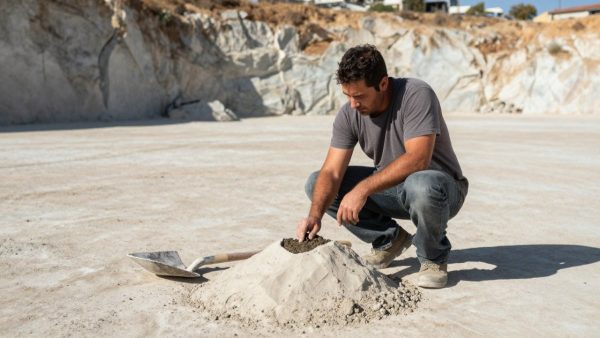
The most common mistake in aggregate testing happens before a single sieve is shaken: a bad sample. If your sample isn’t representative, every number after it is fiction.
A representative sample is a portion of material collected so that its properties match the whole lot within acceptable tolerance. A handful off the top of a stockpile samples only the driest, coarsest part of the pile, not the lot.
Use these steps:
A lot is the quantity of material produced under uniform conditions that your test results will represent. Define it before you sample, not after.
Chain of custody matters because a test result is only as trustworthy as the paper trail behind it. If a result gets challenged, that log is your defense. For acceptance testing, follow the sampling guidance in ASTM C136 on sieve analysis of fine and coarse aggregates and the broader practice standards your spec cites.
Gradation is where most quality arguments start. The aggregate gradation test measures how particles are distributed across size ranges, and that distribution drives workability, strength, and permeability.
Particle-size distribution is the proportion of material falling into each size fraction, from fine sand up to large coarse aggregate. A well-graded mix has particles across the range; a gap-graded mix is missing sizes in the middle.
Why does it matter so much? Because the voids between big particles need smaller particles to fill them. Get the distribution wrong and you get:
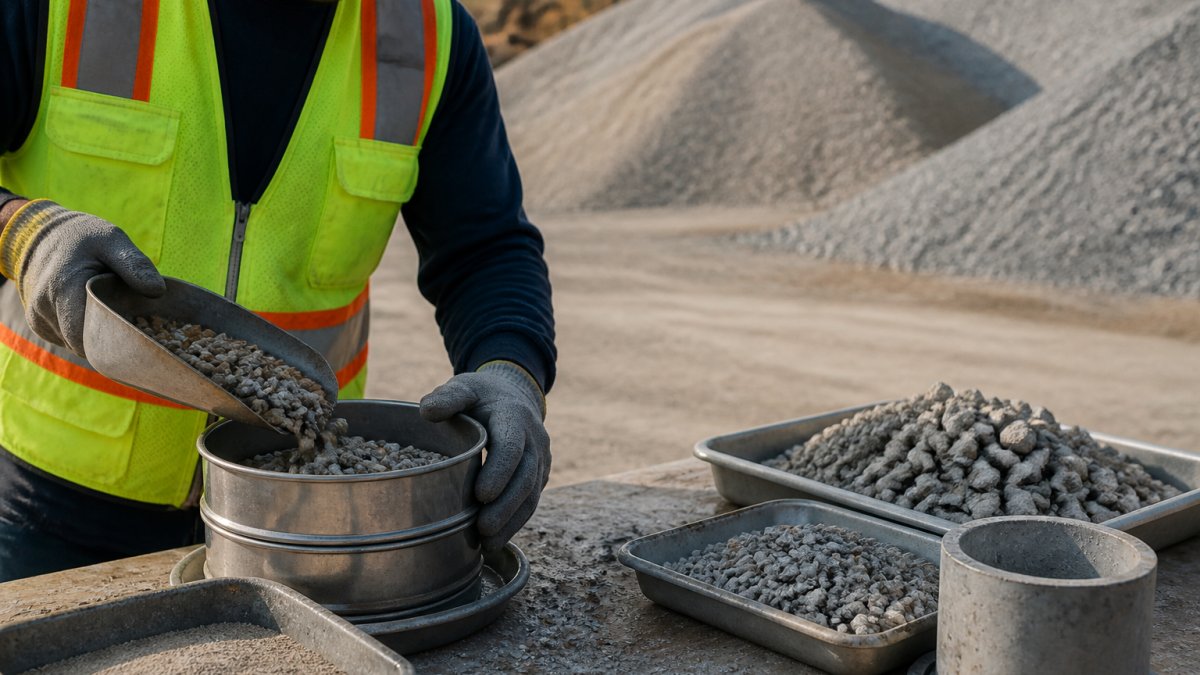
The gradation of aggregate by sieve analysis is the lab method that produces the particle-size distribution. You stack sieves from coarse to fine, shake a known mass through them, and weigh what stays on each.
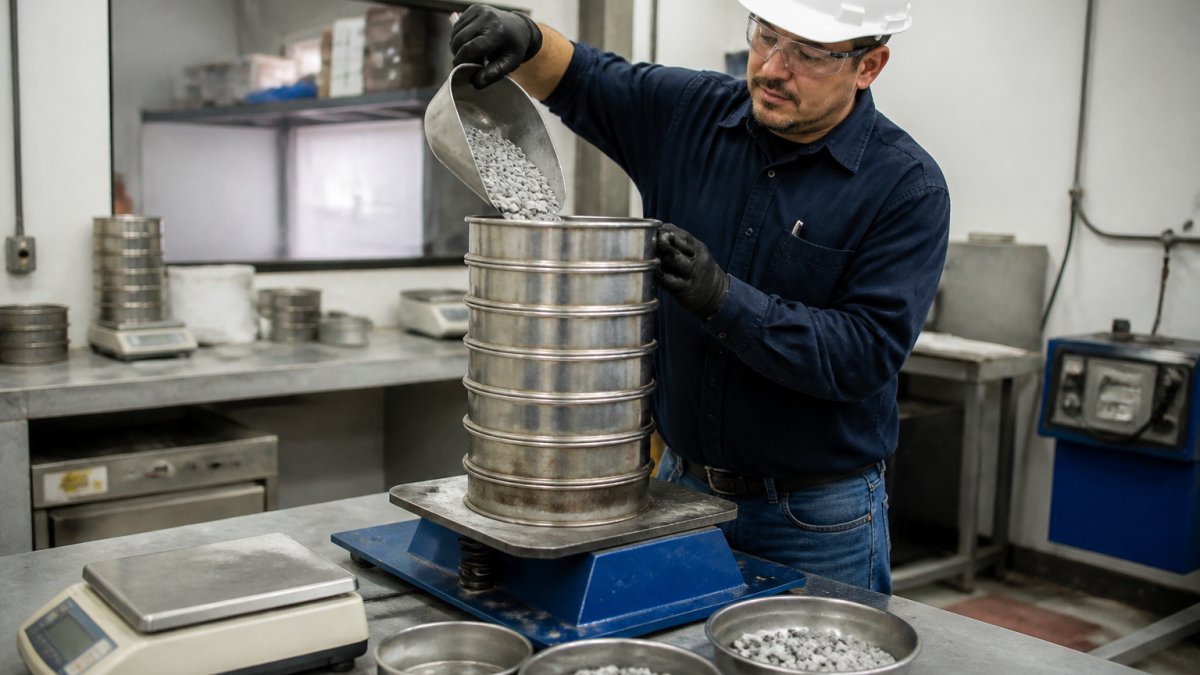
The math is simple once you see it:
Percent passing is the number your spec actually limits. Here’s how the pieces fit:
| Term | What it means | Why it matters |
|---|---|---|
| Total mass | Starting dry weight of the sample | The baseline for every percentage |
| Percent retained | Mass left on one sieve ÷ total mass | Shows how much sits in each size |
| Cumulative percent retained | Running total across sieves | Tracks the full distribution |
| Percent passing | 100 minus cumulative retained | The number specs usually limit |
A gradation report lists each sieve size against its percent passing, so you can compare directly to the spec band. If you want to see what a tightly graded material looks like in practice,
Here’s the part most guides skip. A perfect gradation curve tells you nothing about whether the rock will survive a freeze, a heavy load, or years of traffic.
Abrasion resistance measures how much a material wears under mechanical action. Ensuring such mechanical integrity remains vital across all construction phases, much like the rigorous inspection protocols required to maintain structural steel weld quality.
Soundness measures resistance to weathering and freeze-thaw cycles.
Toughness covers how the material handles impact and load. The standard impact test drops a weighted hammer onto a measured sample and reports the percent fines generated; lower is better.
A material can pass gradation and still fail durability.
Where these tests matter most:
Watch out: a supplier’s gradation report alone will not tell you whether the source rock is durable.
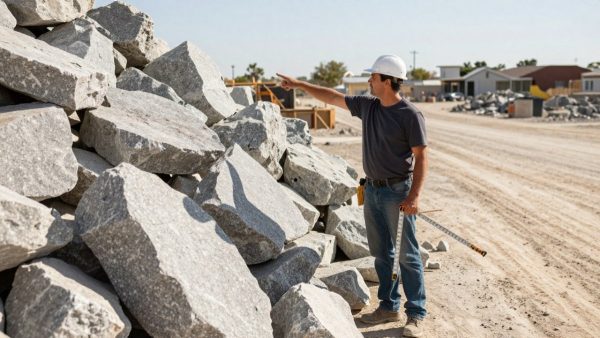
For erosion control work specifically, matching rock size and durability to the site is its own decision. Our guide on choosing the right rip rap covers how to size and select rock that holds up.
Moisture is the silent troublemaker. Surface moisture is water clinging to particle surfaces, and it changes your effective water content in a mix. Absorption is how much water the particles themselves soak up.
Both numbers shift your mix design. Skip them and your water-cement ratio drifts, and strength drifts with it.
Deleterious materials are the things you don’t want: clay lumps, organic matter, soft particles, and excess fines. They weaken bonds and cause staining, popouts, and poor durability.
Watch out: excess fines in crushed or manufactured sands are a common failure point, so check fines content before you commit. To see this material and its typical characteristics, view Polvillo de Quebradora (Crusher Fines). A National Ready Mixed Concrete Association resource on aggregate testing is a solid reference for how moisture and deleterious limits get applied in practice.
A test result means nothing until you compare it to a limit. ASTM C33 is the standard specification for concrete aggregates, and it sets limits on gradation, deleterious substances, and soundness. But the spec is only half the comparison, your project contract may be stricter, and the intended use determines which tests even apply.
Not every aggregate needs every test. Running the wrong suite wastes money; skipping the right one leaves you exposed. Use this matrix as a starting point, then confirm against the project spec:
| Intended use | Gradation | LA abrasion | Soundness | Absorption / specific gravity | Deleterious / clay lumps |
|---|---|---|---|---|---|
| Concrete aggregate | Required (ASTM C33 band) | Optional | Required | Required | Required |
| Asphalt surface course | Required | Required | Optional | Required | Required |
| Base course / structural fill | Required | Required | Optional | Optional | Required |
| Riprap | Size check | Optional | Required | Optional | Optional |
If a test is not called out in the contract but the application demands it, raise the question before the material ships. A supplier who cannot produce the relevant report for the lot is a risk, not a bargain.
A gradation band is a pair of limits, a minimum and maximum percent passing, for each sieve size. Plot your measured percent passing against the band: inside passes that sieve, outside fails it. Do not average across sieves or round a result into compliance. One sieve outside the band is a failing gradation, even if every other sieve is perfect.
Watch out: a supplier may offer a passing report from a different lot or source. Match the report to the delivery ticket and the lot you actually received before you accept the material.
Most failed tests trace back to a handful of fixable errors. Here’s the troubleshooting checklist we’d run first.
| Problem | Likely cause | Fix |
|---|---|---|
| Results vary wildly between samples | Non-representative sampling | Resample from multiple points, use a splitter |
| Percent passing misses the band | Wet sample or clogged sieves | Dry the sample, clean and inspect sieves |
| Fines content too high | Over-crushing or dirty stockpile | Check production, resample from a fresh lot |
| Durability test fails | Weathered or soft source rock | Verify source, request soundness data |
| Moisture readings inconsistent | Sample exposed before weighing | Seal samples, weigh promptly |
A common mistake is sampling once and treating it as the truth for the whole lot. Spot-check across the lot and log every result. If numbers keep drifting, the problem is usually the sampling, not the material.
Verification only works if the material behind the test report is consistent batch to batch. That’s the part you can’t test your way out of.
FST Sand has supplied construction aggregates across Southern California since 1964. We’re a family-owned company, and our range covers crushed stone, gravel, concrete sand, and riprap.
If you want to see test documentation before you commit to a bulk order, ask us. Request a quote and we’ll walk you through the material you need.
Start with the supplier’s documentation: request gradation reports, soundness and abrasion results, and absorption data tied to the specific lot you are buying. Confirm the material meets ASTM C33 or your project specification before delivery. On arrival, inspect visually for excess fines, clay lumps, or organic staining, and pull a representative sample for a sieve analysis.
The five core tests are sieve analysis for gradation, abrasion resistance (Los Angeles machine) for toughness, soundness (sodium or magnesium sulfate) for durability, absorption and specific gravity for moisture behavior, and deleterious materials screening for contaminants. Together they cover particle-size distribution, wear resistance, freeze-thaw durability, and cleanliness. Your project specification may require only some of these, so match the test list to the intended use before you order.
A gradation test dries a sample, splits it to a test size, and shakes it through a stack of sieves. Each sieve’s percent retained is calculated against the total mass, then cumulative percentages are plotted on a gradation report. Compare the curve against the specification limits for your material class. A curve that drifts outside the band, or a fine aggregate with too many fines passing the No. 200 sieve, signals a quality problem worth rejecting or re-testing.
ASTM C33 is the standard specification for concrete aggregates, covering grading limits, deleterious substance limits, soundness, and abrasion requirements. Concrete sand and coarse aggregate that meet ASTM C33 give you predictable workability, strength, and durability. Ask your supplier for test data showing compliance with ASTM C33 for the specific material and lot. If the paperwork is missing or the gradation falls outside the C33 bands, treat the material as unverified until independent testing confirms it.
Consistent aggregate starts with a supplier who can prove what’s in the pile. Get started with FST Sand and build on material you can verify, from the first sample to the final pour.
Silt vs clay in sand decides drainage, compaction and stability. Compare particle size, plasticity and field tests to judge your aggregate before pouring.

Learn how to fix sinking patio pavers step by step, from diagnosing the low spot to resetting stones and refilling joints with polymeric sand.
Calculate riprap material quantity with a step-by-step workflow from cubic yards to tons, then order the right amount with confidence.