
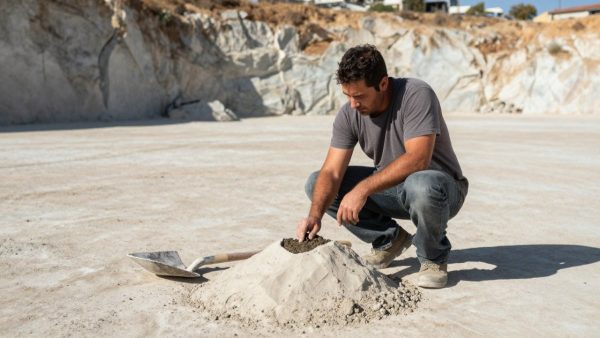
Silt vs Clay in Sand: Key Differences Explained
Silt vs clay in sand decides drainage, compaction and stability. Compare particle size, plasticity and field tests to judge your aggregate before pouring.
Quick Summary
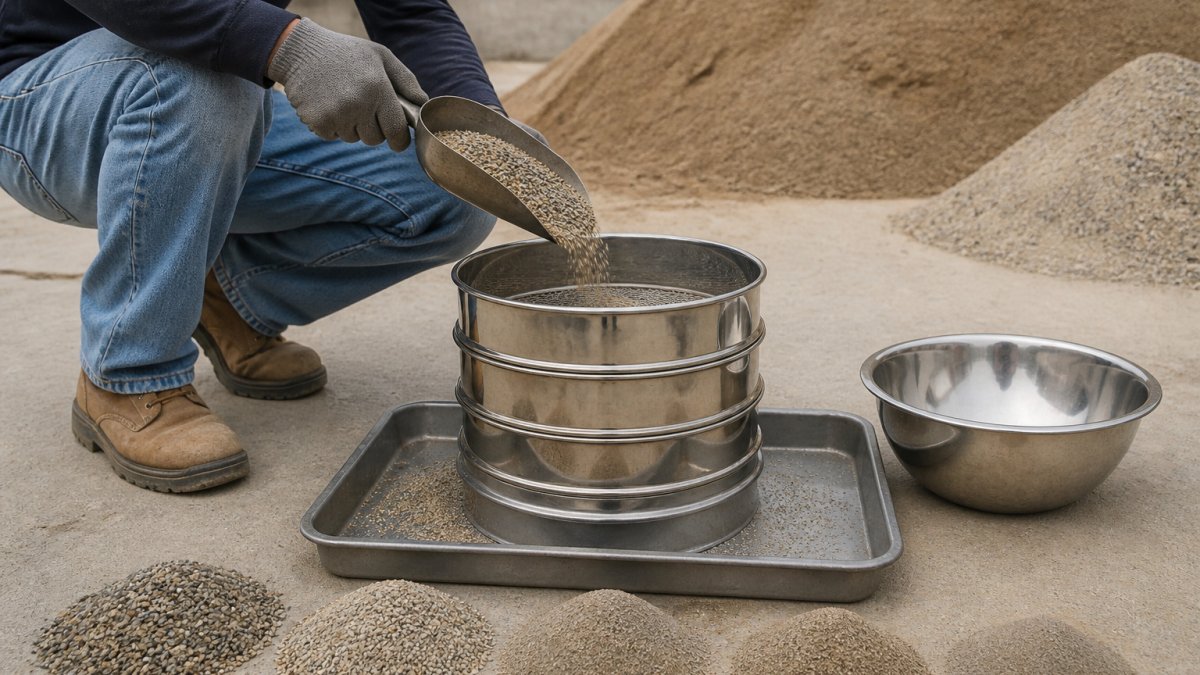
Sand gradation is the spread of particle sizes in a sand sample, usually shown as the percent passing each sieve size. You test it by sieving a dry, representative sample under ASTM C136, then calculating percent passing and fineness modulus for each sieve.
Why Sand Gradation Matters for Concrete Strength and Workability
Sand gradation is the spread of particle sizes in a sand sample, and it decides how much water and cement a concrete mix needs. Too many fines and the mix wants more water. Too few and it turns harsh and hard to place. The reasons come down to a few simple facts. Properly balanced aggregates ultimately create a stable foundation for stamping concrete surfaces that require a consistent and workable paste.
Sand gradation is the distribution of particle sizes within a sample of fine aggregate, usually shown as the percent passing each sieve size. Good gradation fills the voids between larger particles so the cement paste does not have to fill them.
Gradation affects three things you can feel on the job:
Testing the sand first can help identify gradation issues before a pour.
Step 1: Gather Equipment and Follow ASTM C136 Requirements
The standard test method for this work is ASTM C136, which covers sieve analysis of fine and coarse aggregates (C136 Standard Test Method for Sieve Analysis of Fine and Coarse Aggregates). You need the right tools and a clear procedure.
ASTM C136 is published by ASTM International, and you can review the method directly at ASTM C136 Standard Test Method for Sieve Analysis of Fine and Coarse Aggregates. Read the current revision before you start.
Gather these items before you test:
Check that the sieves are clean and undamaged. A torn or clogged mesh gives false readings that carry through every calculation.
Step 2: Prepare a Representative, Oven-Dry Sample
A test is only as good as the sample. Take material from several spots in the pile, not just the top, and mix it before you split off the test portion. This is called getting a representative sample.
Dry the sample to constant mass in the oven. Constant mass means the weight stops changing between two weighings a few hours apart. Wet sand reads heavier and skews the percent passing values, so do not skip this step.
Record the total dry mass before you sieve. You will need that number for every calculation that follows.
Step 3: Run the Sieve Analysis, Dry or Washed
Choose your method before you start. A dry sieve analysis and a washed sieve analysis are two approaches described for testing sand.
For a dry test:
For a washed test, rinse the sample over the No. 200 sieve first to remove fines, dry it again, then sieve as above. Record the mass lost during washing, because it tells you how much material passed the No. 200.
Step 4: Calculate Percent Passing Sieve Values
Each sieve’s result is the mass retained, divided by the total dry mass, times 100. Then work from the largest sieve down, adding each retained percent to get the cumulative percent retained. Percent passing is 100 minus the cumulative percent retained.
Here is a worked example with a 500-gram sample:
| Sieve | Retained (g) | Percent Retained | Cumulative % Retained | Percent Passing |
|---|---|---|---|---|
| No. 4 | 0 | 0.0 | 0.0 | 100.0 |
| No. 8 | 15 | 3.0 | 3.0 | 97.0 |
| No. 16 | 80 | 16.0 | 19.0 | 81.0 |
| No. 30 | 135 | 27.0 | 46.0 | 54.0 |
| No. 50 | 150 | 30.0 | 76.0 | 24.0 |
| No. 100 | 85 | 17.0 | 93.0 | 7.0 |
| Pan | 35 | 7.0 | 100.0 | 0.0 |
Check your work by confirming the retained masses add up to the original sample mass, within a small allowance for loss. Large mismatches usually mean a spill or a weighing error.
Step 5: Compute Fineness Modulus and Read the Aggregate Gradation Report
The fineness modulus is a single number that summarizes the sand’s coarseness. Add the cumulative percent retained on the standard sieves (No. 4, No. 8, No. 16, No. 30, No. 50, and No. 100), then divide the total by 100.
Using the example above: 0 + 3 + 19 + 46 + 76 + 93 = 237, and 237 divided by 100 gives a fineness modulus of 2.37. Lower fineness-modulus numbers mean finer sand, and higher numbers mean coarser sand.
Read the aggregate gradation report by looking at the pattern, not just the single number.
Checking Results Against Grading Limits and Booking Your Next Sand Order with FST Sand
Compare your percent passing values against the grading limits in your project specification or the applicable ASTM C33 requirements for fine aggregate. Compare the results with the grading limits in your project specification or the applicable ASTM C33 requirements for fine aggregate. If your sand falls outside those limits, consider washed plaster sand that is properly graded for your application.
Ready to order? Request a quote for sand that matches your gradation needs.
Dry a representative sand sample to constant mass, then pass it through a stack of sieves from coarse to fine. Weigh the material retained on each sieve, convert each mass to a percentage of the total sample, and accumulate those values to get percent passing for each sieve size. Compare the results with the grading limits in your project specification.
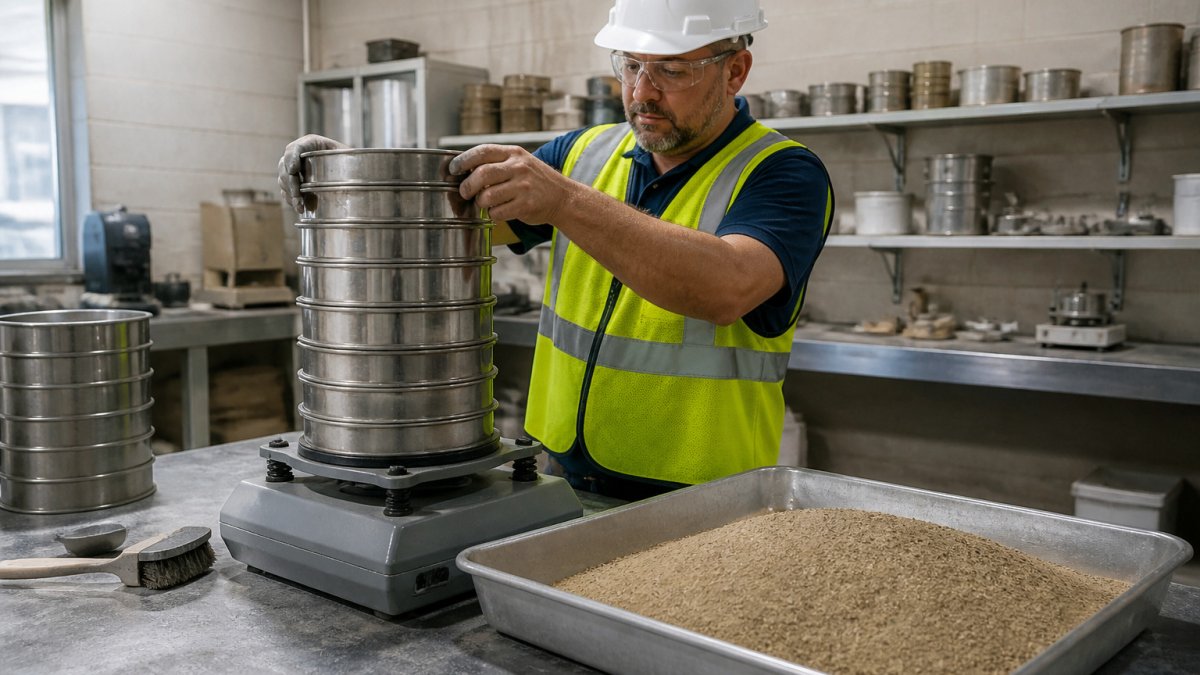
You need a balance, a set of test sieves with the sizes called out in your specification, a sieve shaker, pans and brushes, and an oven capable of drying the sample to constant mass. A washed analysis also requires a wash sieve and water. Keep the sieves clean and check for damaged mesh before testing.
Percent retained on a sieve equals the mass retained divided by the total dry sample mass, multiplied by 100. Cumulative percent retained is the running total of those values from the coarsest sieve down. Percent passing equals 100 minus the cumulative percent retained. For example, if a 500 gram dry sample leaves 45 grams on the No. 16 sieve and 80 grams on the No. 30 sieve, the cumulative retained values are 9 and 25 percent, so the percent passing the No. 30 sieve is 75 percent.
Test frequency depends on your project specification and quality control plan. Confirm the required frequency with your engineer of record or project specification before you set your schedule.
Silt vs clay in sand decides drainage, compaction and stability. Compare particle size, plasticity and field tests to judge your aggregate before pouring.
Learn how to fix sinking patio pavers step by step, from diagnosing the low spot to resetting stones and refilling joints with polymeric sand.
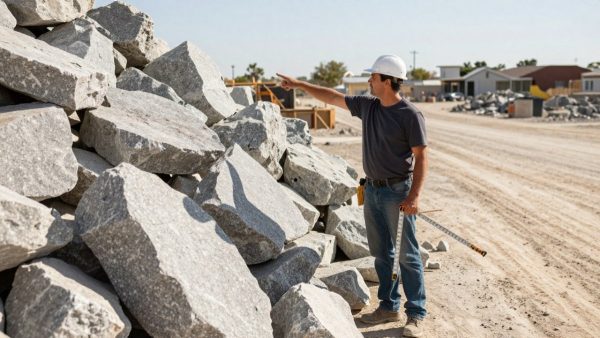
Calculate riprap material quantity with a step-by-step workflow from cubic yards to tons, then order the right amount with confidence.