
Silt vs Clay in Sand: Key Differences Explained
Silt vs clay in sand decides drainage, compaction and stability. Compare particle size, plasticity and field tests to judge your aggregate before pouring.
Last Updated: November 18, 2026
Quick Summary
Moisture makes a sand sieve test read coarser than the true gradation because water glues fine particles into clumps and blinds the mesh, so fines are retained instead of passing. Dry the sample to constant mass, weigh it dry, and report all percentages from the dry mass.
Water changes how a sand sieve test reads because it glues fine particles together and adds weight that is not aggregate.
Here is the core problem. Sieve analysis measures particle size by mass. Water adds mass that belongs to no sieve opening.
A sample that looks fine in the field can test coarse in the lab, or the reverse, depending on how wet it was when weighed.
The fix is straightforward but easy to skip: dry the sample, weigh it dry, and report the dry mass. Everything below explains how moisture biases results and how to remove that bias.
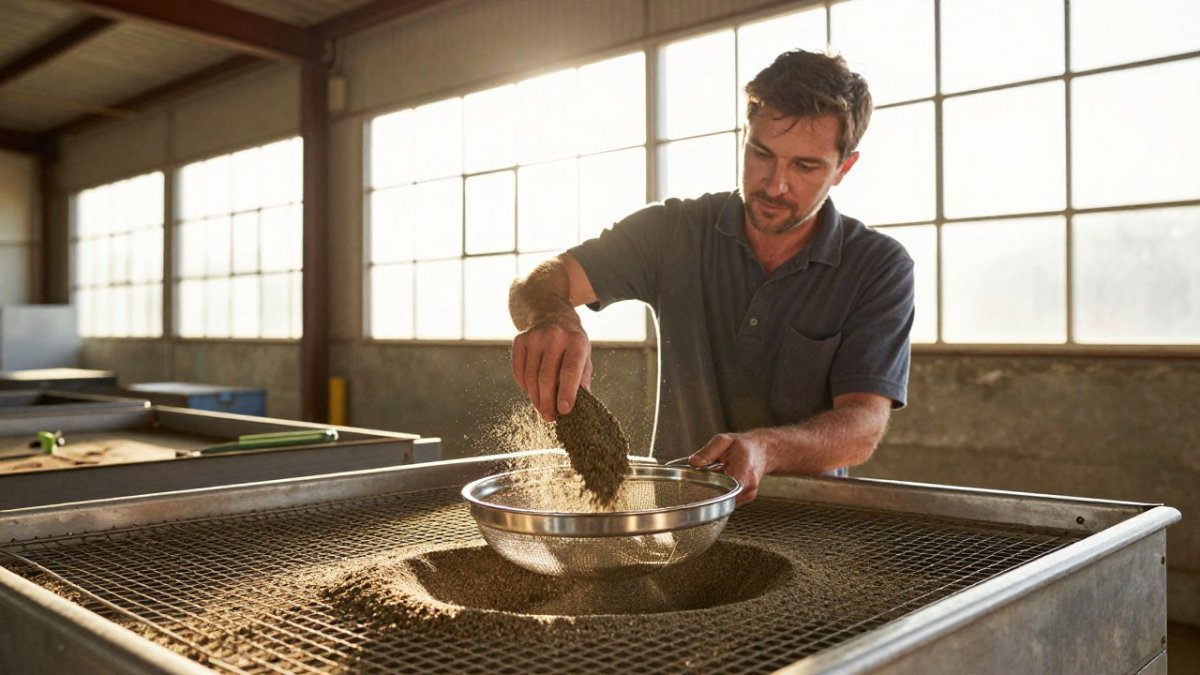
Wet sand fails in two specific ways: clumping and blinding. Both distort the mass retained on each sieve, and both are avoidable.
Clumping happens when moisture binds fine particles into larger clusters. A cluster of silt and fine sand behaves like a single coarse grain.
Blinding is the opposite failure. Damp fines smear across the mesh and block the openings. Material that should pass stays on top.
Watch out: blinding is easy to miss because the sieve looks loaded, not blocked. Tap the frame.
The practical answer is to dry the sample before sieving.
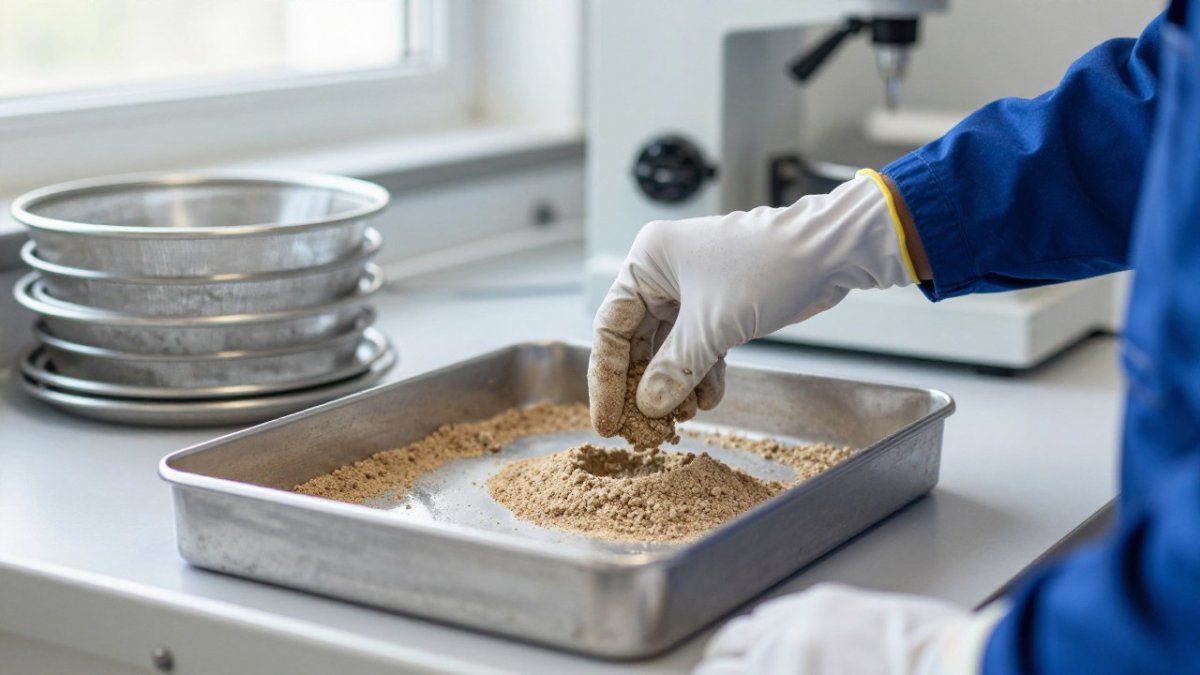
A sand moisture content test tells you how much water the sample carries before you commit to sieving. Run it first, every time.
The method is simple:
That number does two jobs. It lets you correct a damp mass to a dry basis, and it flags samples wet enough to clump or blind.
A common mistake is skipping this step because the sample “looks dry.” Surface-dry sand can still hold enough moisture in the fines to cause adhesion. If you are unsure, run the moisture test.
Drying and preparing sand for sieve analysis is a fixed sequence. Follow it in order and the moisture bias disappears.
If you need a fine reference material for comparison work, our rock dust page covers a product that behaves much like the fines in a graded sand.
Sieve analysis test results should always be read against the dry mass, never the damp mass. When they are not, the percentages retained and passing are wrong in a predictable direction, and the size of the error is often larger than the tolerance in a gradation specification.
Here is what moisture does to the numbers:
| Moisture Condition | Typical Effect on Result | What It Looks Like |
|---|---|---|
| Bone dry | Baseline, true gradation | Percentages sum to 100 |
| Surface damp | Slight coarsening from clumping | Extra mass on coarse sieves |
| Wet fines present | Blinding and false coarse reading | High retained mass, low passing |
| Very wet | Mass balance fails | Fractions do not sum to dry mass |
Suppose a 500.0 g oven-dry sand sample is tested correctly and reports 10.0 percent passing the No. 200 (75 µm) sieve, or 50.0 g.
The reverse error happens when clumps of wet fines sit on a coarse sieve. A 15 g cluster of silt and fine sand behaves like one coarse particle, inflating the mass retained on the No. 4 (4.75 mm) or No. 8 (2.36 mm) sieve and making the sand read coarser at the top end as well.
The mass-balance check is your best defense against a moisture-biased result. Add the mass retained on every sieve, plus the pan, and compare that total to the initial dry mass.
Watch out: a mass balance that sums correctly does not prove the sample was dry. Water that stays with the fines through the whole stack can still produce a total that closes while the individual fractions are wrong. Always confirm dryness to constant mass before you trust the balance.
When fines content looks off, compare it against a known fine aggregate. Our crusher fines page shows what a clean fine product should look like.
A sieve analysis graph is only valid when it is built from dry masses. If your sample started damp, correct it before you plot.
The steps:
If you plotted from damp masses by mistake, the curve will shift toward the coarse side. Recalculate from the dry mass before you submit anything.
For graded base samples, it helps to compare your curve against a known spec. Our crushed aggregate base page lists the gradation a properly graded base should meet.
Most sieve analysis problems with solutions come down to one root cause: uncontrolled moisture. The table below maps the symptoms you will actually see in the lab to likely moisture-related causes and the corrective action that resolves them.
| Symptom | Likely Cause | Fix |
|---|---|---|
| Fractions do not sum to dry mass | Sample still damp | Dry to constant mass, reweigh |
| Too much mass on coarse sieves | Clumping of fines | Break clumps, dry sample |
| Low percent passing on fine sieves | Blinding | Clean sieves, reduce load |
| Results vary between runs | Inconsistent moisture | Standardize drying before every test |
| Repeatability fails | Overloading or wet fines | Halve the load, dry the sample |
| Fines lost during washing | Decanting too fast | Settle, rinse the sieve, catch the wash water |
Use this sequence when a sand sample arrives damp and you are not sure how to proceed.
Watch out: washing a sample that was not dried first gives you a moisture-corrected mass you cannot reconstruct. Always record the dry mass before any water touches the sample.
Report the moisture condition you tested. A result labeled “oven-dry” is not interchangeable with one labeled “as-received,” and a specification that cites a standard is usually written around the oven-dry basis. Distinguish required procedure from general lab advice: if the governing standard specifies oven drying, air drying is not an acceptable substitute no matter how consistent your results look. ASTM International standards for sieve analysis is the reference most specifications point to for the drying and mass basis.
To separate moisture effects from genuine gradation differences, test replicate portions at the same moisture condition. Running two splits of the same sample and comparing percent passing on the finest sieve can reveal whether moisture, loading, or blinding is still in play. Once replicates agree at a controlled dry condition, any remaining difference between lots reflects real gradation, not water.
If you are troubleshooting clumping in clean, uniform material, it helps to compare against a rounded aggregate. Our pea gravel page shows how a uniform product should behave.
The most reliable way to avoid moisture bias is to start with consistent material. FST Sand has supplied construction aggregates since 1964.
What that means for your testing:
We work with contractors, developers, and homeowners alike. If you want to see what we carry, browse our full materials catalog before you order.
Moisture is the quiet variable that breaks sand sieve test results. Control it, and your gradation data becomes trustworthy. FST Sand can help you start with material that tests the same way twice, backed by more than six decades of processing experience and a family-owned team that stands behind every load. Get started with FST Sand and build on aggregates you can verify.
Moisture makes fine particles stick together and cling to coarser grains, so a wet sample behaves as if it has more gravel and less fines than it really does. Sieve openings also blind over when damp sand cakes on the mesh. The result is a gradation curve shifted toward the coarse side, which can make a failing sand look acceptable. Drying the sample to a constant mass before weighing removes most of this bias.
Yes. Dry the sample to a constant mass in an oven at the temperature your test method specifies, then cool it before weighing. Air drying works for routine checks but takes longer and depends on humidity. If the sand contains lumps of silt or clay, wash it over the fine sieve, dry the retained material, and then run the stack. Record the dry mass as your initial sample mass so every percentage is calculated on the same basis.
It almost always makes sand appear coarser. Fine particles agglomerate into pellets that stay on larger sieves, and damp fines adhere to coarse grains instead of passing through. Both effects push mass upward on the coarse sieves and downward on the pan. The exception is heavy blinding, where wet material plugs the openings and traps fines that should have passed, which distorts the middle of the curve as well.
Overloading a sieve, using a stack out of order, sieving for too short a time, and losing material during transfer all skew results. So does an uncalibrated scale or a sample that was not reduced representatively. Run a mass-balance check: the sum of mass retained on every sieve plus the pan should come within about 1 percent of the initial dry mass. If it does not, find the loss before you trust the gradation curve.
Silt vs clay in sand decides drainage, compaction and stability. Compare particle size, plasticity and field tests to judge your aggregate before pouring.
Learn how to fix sinking patio pavers step by step, from diagnosing the low spot to resetting stones and refilling joints with polymeric sand.
Calculate riprap material quantity with a step-by-step workflow from cubic yards to tons, then order the right amount with confidence.